

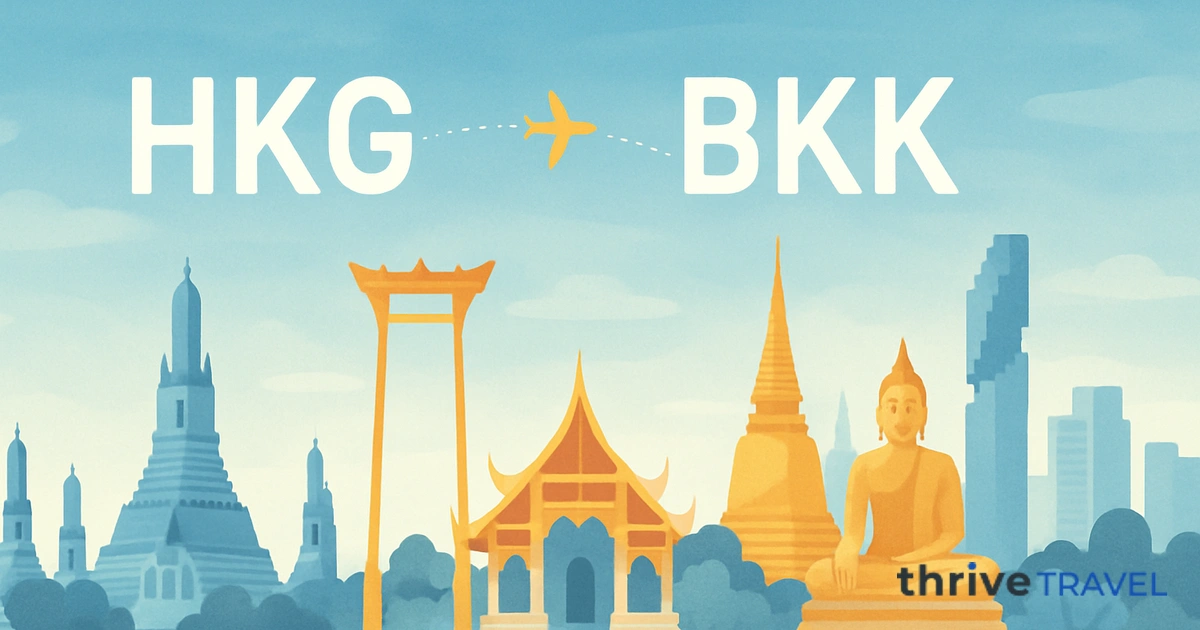
The route from Hong Kong to Bangkok remains one of the busiest air corridors in Southeast Asia, connecting two cities that couldn't be more different yet share an infectious energy that keeps travelers coming back. With a flight time of roughly two hours and forty-five minutes, this short hop across the South China Sea delivers passengers from one of the world's most vertical cities to one of its most sprawling. It's a journey that millions make each year for business, leisure, and everything in between.
Several major carriers operate flights from Hong Kong to Bangkok daily, giving travelers plenty of flexibility. Cathay Pacific and its regional subsidiary offer multiple departures throughout the day, while Thai Airways provides equally frequent service from the Bangkok side. Budget-conscious flyers can look to HK Express or Thai AirAsia, both of which keep fares competitive on this popular route. With so many options, finding a departure that fits your schedule is rarely a problem.
Timing your trip matters more than you might think. Bangkok's cool season, stretching from November through February, brings pleasant temperatures in the low thirties and significantly less humidity. This coincides with peak tourist season, so expect fuller flights and higher hotel rates. The shoulder months of March and October can offer a nice balance between tolerable weather and thinner crowds. Avoid April if you're sensitive to heat, as Bangkok regularly pushes past 40 degrees Celsius before the monsoon rains arrive in May.
Hong Kong International Airport at Chek Lap Kok makes the departure experience relatively painless. The airport's efficient design and excellent public transport connections via the Airport Express train mean you can be checking in within 25 minutes of leaving central Hong Kong. On arrival, Bangkok's Suvarnabhumi Airport has improved its immigration processing considerably in recent years, though evening arrivals can still face longer queues. The Airport Rail Link into central Bangkok takes about 30 minutes and costs a fraction of a taxi fare.
One practical tip worth noting is that many travelers use this connection as a springboard. Bangkok serves as a natural hub for onward journeys to Thailand's islands, northern hill country, or even neighboring countries like Cambodia and Laos. Booking your Hong Kong to Bangkok leg separately from domestic Thai flights sometimes yields better overall pricing than a single through-ticket.
What makes this particular corridor so appealing is the contrast it offers. You leave a city defined by its harbor skyline and Michelin-starred dim sum, and land in a metropolis famous for ornate temples, legendary street food, and a nightlife scene that never seems to sleep. For a flight shorter than most movies, the cultural shift is remarkably dramatic.