

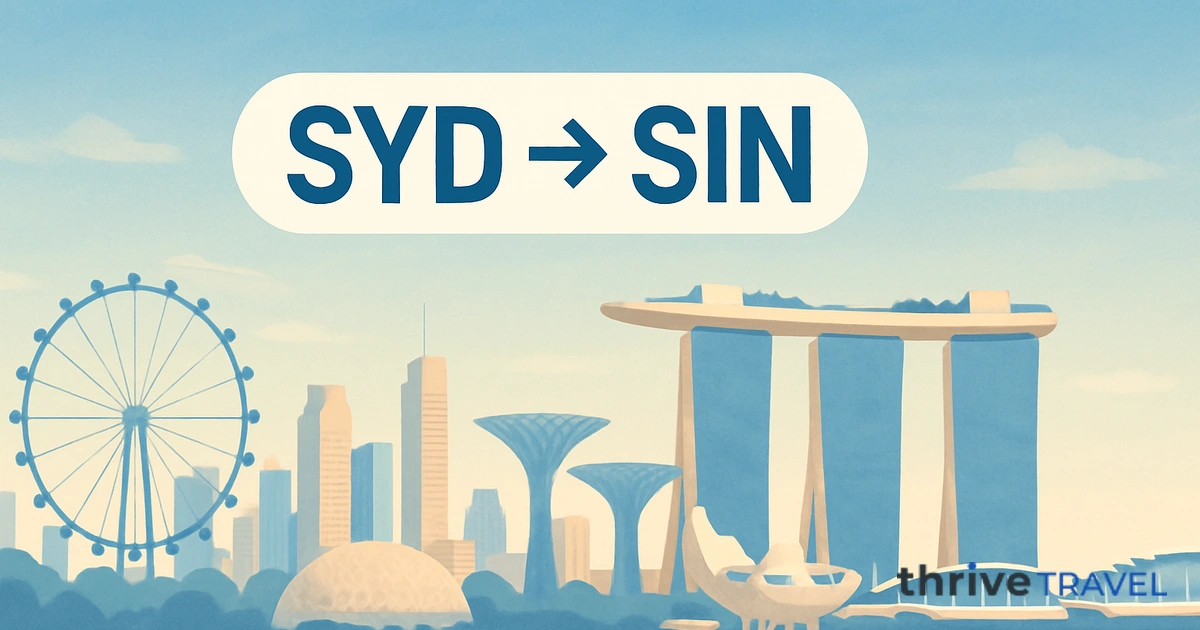
The journey from Sydney to Singapore is one of the busiest and most rewarding long-haul connections in the Asia-Pacific region. Covering roughly 6,300 kilometres, the flight typically takes around eight hours westbound and closer to seven and a half on the return, thanks to prevailing winds. It is a popular route for business travellers heading into Southeast Asia, holidaymakers using Singapore as a gateway to Europe, and families visiting relatives across the region.
Several airlines compete on this corridor, which generally means good service and reasonable schedules. Singapore Airlines and Qantas operate multiple daily departures, often using widebody aircraft such as the Airbus A380 or Boeing 787. Budget-conscious travellers can look to Scoot or Jetstar, both of which offer no-frills options that still cover the distance comfortably. Business class cabins on this sector are known for being competitive, particularly on Singapore Airlines, where the route is a flagship service.
Most flights depart Sydney either in the morning or late evening, arriving in Singapore at times that make onward connections easy. Changi Airport is consistently ranked among the world's best, with efficient transit, indoor gardens, and even a rooftop pool, which helps make longer layovers feel less like a chore. On the return leg, Sydney Kingsford Smith handles international arrivals smoothly, though early-morning landings can mean a wait for hotel check-ins.
When it comes to timing, the shoulder seasons of April to June and September to early November tend to offer the best balance of weather and fares. Singapore is tropical year-round, so expect warmth and humidity whenever you arrive, with brief afternoon showers common between November and January. Sydney, meanwhile, is at its most pleasant during the Australian spring and autumn. Avoiding school holidays in both countries can also make a noticeable difference to ticket prices and cabin crowding.
A few practical tips help make the Sydney to Singapore journey more enjoyable. Stay hydrated during the flight, as the dry cabin air over such a long sector can be tiring. If you are prone to jet lag, adjusting your sleep schedule a day or two before departure eases the two- to three-hour time difference. Pack light layers, since aircraft cabins can be cool even when your destination is sweltering.
What makes this route particularly interesting is how it links two very different worlds: the laid-back coastal energy of Sydney with the compact, cosmopolitan buzz of Singapore. Whether you are travelling for work, leisure, or as a stopover on a longer journey, the flight itself is a comfortable introduction to the contrasts waiting on the other side.