

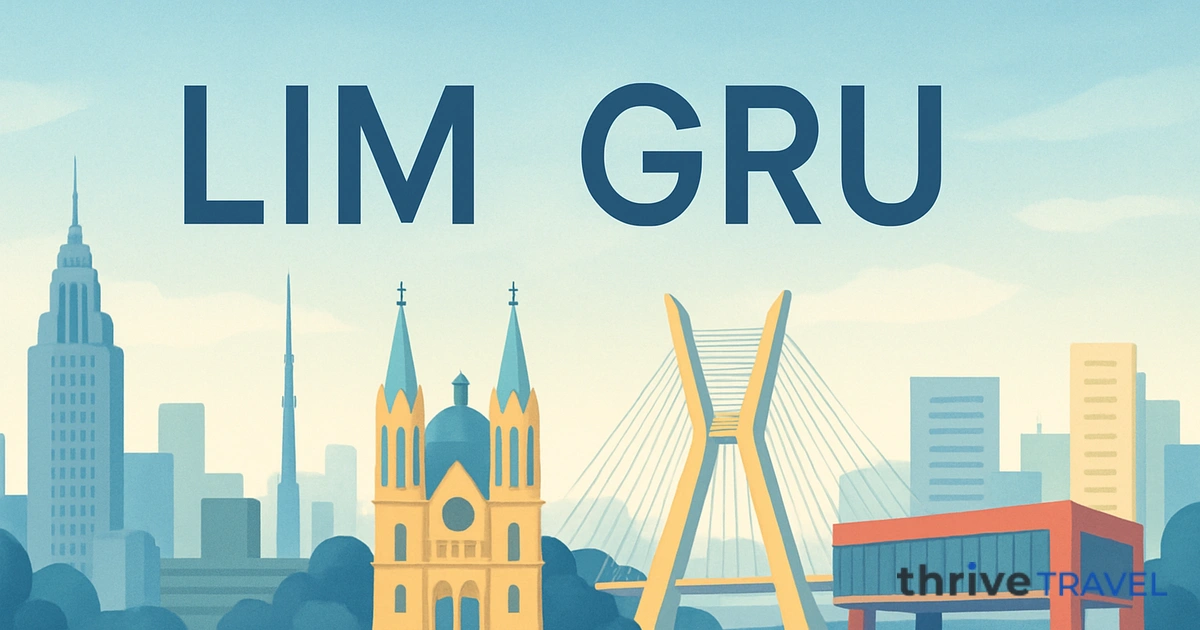
The journey from Lima to São Paulo connects two of South America's most dynamic cities, linking the Pacific coast of Peru with Brazil's bustling financial capital. Covering roughly 3,500 kilometers across the Andes and the vast Amazon basin, the flight typically takes between five and six hours nonstop, depending on wind conditions and the specific routing chosen by the airline.
Several carriers operate this corridor, giving travelers a reasonable choice of schedules and service levels. LATAM dominates with multiple daily nonstop services between Jorge Chávez International Airport and Guarulhos, while Gol, JetSmart, and Sky Airline have added options in recent years, often with one-stop itineraries. Code-share arrangements with international partners also make this a common connection point for travelers heading deeper into Brazil or onward to Europe and Asia.
The best time to fly the Lima to São Paulo route depends on what you want to experience on either end. Lima's coastal climate is mildest between December and April, when skies clear and the famous garúa mist lifts. São Paulo, on the other hand, enjoys its driest, most comfortable weather from April to September. Many travelers find the shoulder months of April, May, and September to be a sweet spot, offering pleasant conditions in both cities and slightly less crowded cabins.
The in-flight experience tends to be straightforward. Most departures from Lima leave late in the evening, arriving in São Paulo in the early morning hours, which is ideal for business travelers but can leave leisure passengers a bit groggy. Daytime flights do exist and are worth seeking out for the spectacular views as the aircraft crosses the snow-capped Andes shortly after takeoff. Onboard service varies by carrier, with full-service options offering meals and entertainment while low-cost operators charge à la carte.
A few practical tips can smooth the journey. Guarulhos is a sprawling airport, so allow extra time for connections, immigration, and the trip into central São Paulo, which can take well over an hour in traffic. Brazil no longer requires visas for most Western travelers, but always check current requirements before departure. Travelers should also be aware that Portuguese, not Spanish, is the language of Brazil, and even basic phrases go a long way.
What makes this route particularly interesting is the cultural contrast at each end. Lima is a culinary capital steeped in pre-Columbian and colonial heritage, while São Paulo pulses with modern energy, immigrant influences, and an unmatched restaurant and nightlife scene. The flight bridges two distinct worlds in a single comfortable hop.