

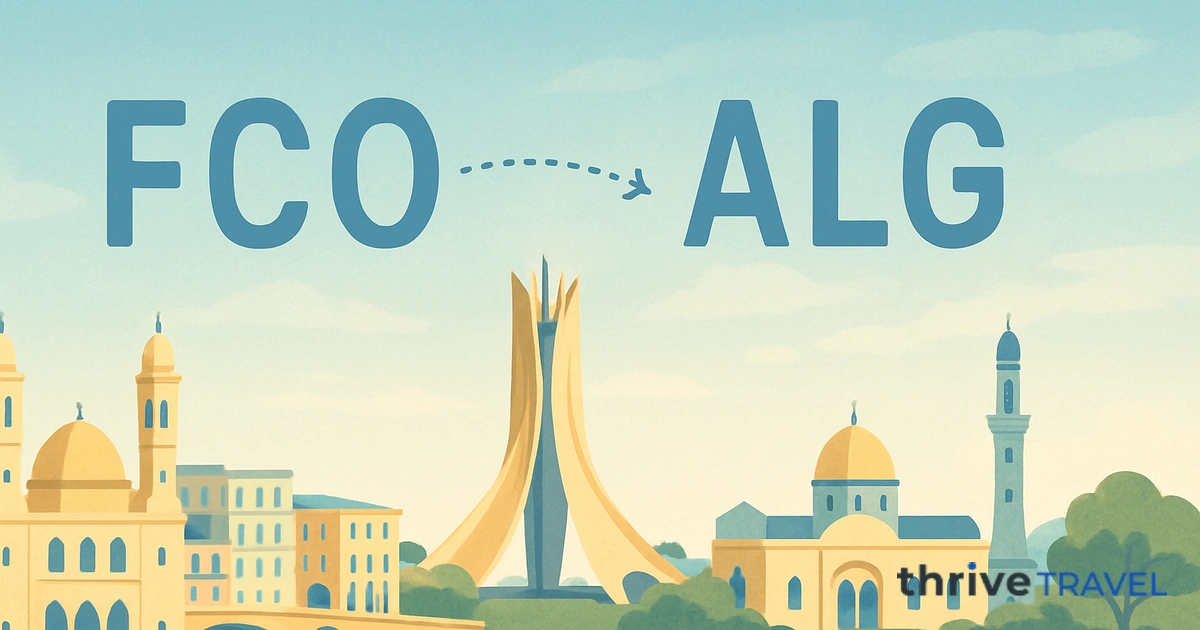
The journey from Rome to Algiers connects two ancient Mediterranean capitals, offering a short but rewarding flight across the sea that separates southern Europe from North Africa. Departing from Leonardo da Vinci International Airport in Fiumicino, travelers typically reach Houari Boumediene Airport in Algiers in just under two hours, making this one of the more accessible crossings between the two continents.
Several airlines operate this route, with Air Algérie and Alitalia's successor ITA Airways being the most prominent carriers. Air Algérie tends to offer more frequent departures, while European carriers occasionally provide connecting options through Paris, Madrid, or Frankfurt. Direct flights are generally the more comfortable choice given the modest distance, and most departures are scheduled in the morning or early afternoon, giving passengers a full day to settle into Algiers upon arrival.
The in-flight experience is straightforward. As the aircraft climbs out of Rome, window seat passengers are treated to sweeping views of the Italian coastline before the deep blue of the Tyrrhenian Sea takes over. On clear days, the mountainous silhouette of Sardinia appears below, followed eventually by the North African coast as the plane begins its descent toward Algiers Bay.
Spring and autumn are widely considered the finest seasons to travel between these cities. From April to June, the Algerian coast enjoys warm days without the intense summer heat, while September and October offer similar comfort along with fewer crowds. Summer months bring higher temperatures in Algiers and increased demand due to family visits and the diaspora returning home, which can push fares upward. Winter travel is quieter and often more affordable, though occasional storms over the Mediterranean can lead to minor delays.
A few practical tips make the trip smoother. Italian and other EU citizens require a visa to enter Algeria, so arranging paperwork well in advance is essential. It is also worth noting that Algerian customs can be thorough, and travelers should carry documentation for any electronics or valuables. Carrying some cash in euros is useful, as exchanging money is easier upon arrival than relying solely on cards.
What makes the Rome to Algiers route genuinely interesting is the cultural transition it represents. In roughly two hours, passengers move from the heart of classical European civilization to a city shaped by Ottoman, French, and Berber influences, where whitewashed casbah alleys spill down toward a working port. For travelers curious about the Mediterranean beyond its familiar European shore, this flight is a compact and fascinating gateway.