

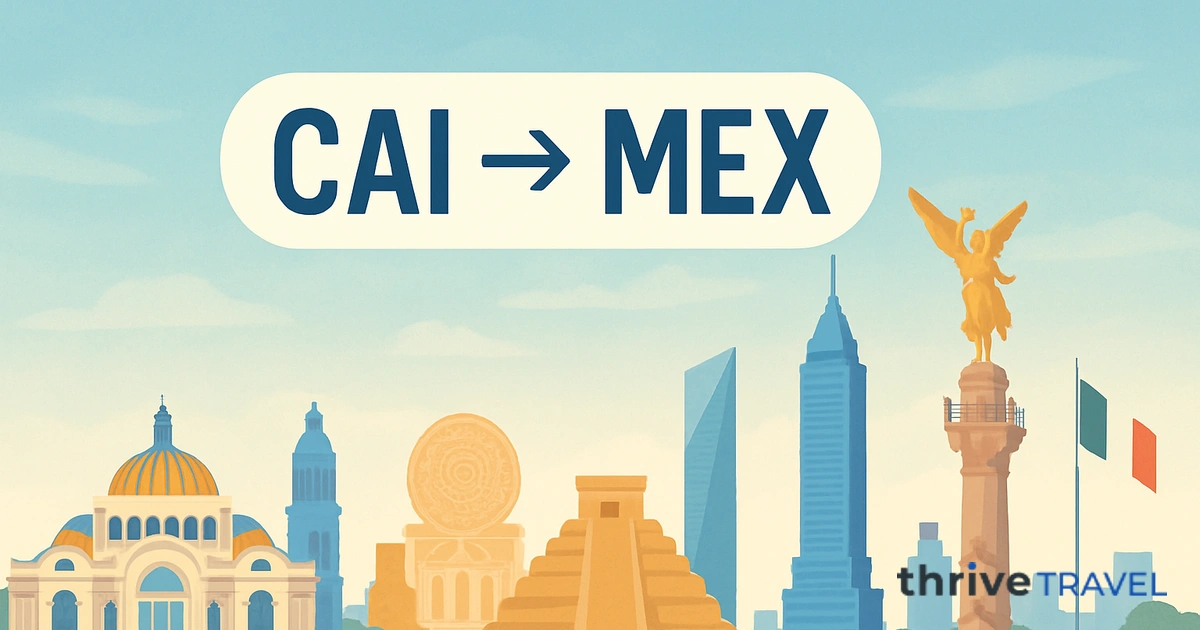
Connecting two of the world's oldest and most culturally rich civilizations, the route from Cairo to Mexico City is one of those rare journeys that feels like traveling between parallel worlds. Both cities are built on the legacies of ancient empires — pharaonic Egypt on one end, Aztec Mexico on the other — making this an unforgettable trip for history lovers and adventurous travelers alike.
There are currently no direct flights between Cairo and Mexico City, so passengers should expect at least one layover. Common routing options include connections through European hubs such as Paris, Madrid, Amsterdam, or Frankfurt. Some travelers opt for a stopover in the United States, passing through cities like New York or Houston, though this requires a US transit visa for Egyptian passport holders, which adds a layer of complexity. European connections tend to be smoother from a visa perspective for many nationalities. Airlines frequently used on this corridor include Air France, KLM, Lufthansa, Turkish Airlines, and Aeromexico on the transatlantic leg. Total travel time typically ranges from 18 to 26 hours depending on the connection.
When planning the timing of your trip, consider the seasons at both ends. Cairo is brutally hot from June through August, while Mexico City enjoys a relatively mild climate year-round thanks to its high altitude. The dry season in Mexico City runs from November to April, making it the most pleasant period for sightseeing. If you are departing Cairo, the cooler months of October through March offer more comfortable conditions for exploring before your flight.
Packing wisely matters on this route. Mexico City sits at over 2,200 meters above sea level, so even tropical-weather travelers from Egypt may need a light jacket for cooler evenings. Altitude sickness is rare but possible, so staying hydrated during your first day is a good idea. The time difference between Cairo and Mexico City is typically eight hours, which means jet lag can be significant. Arriving in the evening and getting a full night of sleep is one of the better strategies for adjusting quickly.
Once in Mexico City, the cultural parallels with Cairo are striking. Both cities are sprawling, vibrant metropolises where ancient ruins sit alongside modern urban life. The National Museum of Anthropology rivals the Egyptian Museum in scope and wonder. Street food culture thrives in both capitals, though the flavors could not be more different — think tacos al pastor instead of koshari.
Flying from Cairo to Mexico City is admittedly a long haul, but for those drawn to civilizations that shaped human history, few routes offer such a profound sense of connection across continents and millennia.